Translate

Saturday, June 28, 2014

Astronomers Discover Rare Triple Supermassive Black Hole System

A team of scientists led by Dr Roger Deane from the University of Cape Town in South Africa has discovered a system of three supermassive black holes – with two of them orbiting each other rather like binary stars – in a galaxy more than 4 billion light-years away from Earth. The discovery could help astronomers in the search for gravitational waves (the ripples in space-time) predicted by Albert Einstein.

Radio images of the triple supermassive black holes system J1502P/SE/SW in the galaxy SDSS J150243.09+1111557.3 and its binary component. Image credit: R.P.Deane et al.
“Einstein’s General Relativity predicts that merging black holes are sources of gravitational waves and in this work we have managed to spot three black holes packed about as tightly together as they could be before spiraling into each other and merging,” said Prof Matt Jarvis from the University of Oxford, who is a co-author of the discovery paper published in the journal Nature.
“The idea that we might be able to find more of these potential sources of gravitational waves is very encouraging as knowing where such signals should originate will help us try to detect these ripples in space-time as they warp the Universe.”
In their study, Dr Deane, Prof Jarvis and co-authors examined six galaxies thought to contain binary supermassive black hole systems.
The astronomers found that one of these galaxies, SDSS J150243.09+1111557.3 (J1502 for short), they thought contained two black holes (J1502P and J1502S) actually contained a triple system with a very compact double supermassive black hole.
They then used the European Very Long Baseline Interferometry Network and the 305-m Arecibo Observatory in Puerto Rico to observe the inner two black holes, J1502SE and J1502SW.
“Very little is actually known about black hole systems that are so close to one another that they emit detectable gravitational waves,” the scientists said.
“This discovery not only suggests that close-pair black hole systems emitting at radio wavelengths are much more common than previously expected,” Prof Jarvis said.
“This exciting discovery perfectly illustrates the power of the Very Long Baseline Interferometry technique, whose exquisite sharpness of view allows us to see deep into the hearts of distant galaxies,” said co-author Dr Keith Grainge from the University of Manchester.

Sunday, June 22, 2014

Swiftly moving gas streamer eclipses supermassive black hole

This is the galaxy known as NGC 5548. At its heart, though not visible here, is a supermassive black hole behaving in a strange and unexpected manner. Researchers detected a clumpy gas stream flowing quickly outward and blocking 90 percent of the X-rays emitted by the black hole. This activity could provide insights into how supermassive black holes interact with their host galaxies.

Researchers detected a clumpy gas stream flowing quickly outward and blocking 90 percent of the X-rays emitted by the black hole in NGC 5548.
Astronomers have discovered strange and unexpected behavior around the supermassive black hole at the heart of galaxy NGC 5548. The international team of researchers detected a clumpy gas stream flowing quickly outward and blocking 90 percent of the X-rays emitted by the black hole. This activity could provide insights into how supermassive black holes interact with their host galaxies.

The discovery of the unusual behavior in NGC 5548 is the result of an intensive observing campaign using major European Space Agency and NASA observatories, including the NASA/ESA Hubble Space Telescope. In 2013 and 2014, the international team carried out the most extensive monitoring campaign of an active galaxy ever conducted.

There are other galaxies that show gas streams near a black hole, but this is the first time that a stream like this has been seen to move into the line of sight.

The researchers say that this is the first direct evidence for the long-predicted shielding process that is needed to accelerate powerful gas streams, or winds, to high speeds. “This is a milestone in understanding how supermassive black holes interact with their host galaxies,” said Jelle Kaastra of the SRON Netherlands Institute for Space Research. “We were very lucky. You don’t normally see this kind of event with objects like this. It tells us more about the powerful ionized winds that allow supermassive black holes in the nuclei of active galaxies to expel large amounts of matter. In larger quasars than NGC 5548, these winds can regulate the growth of both the black hole and its host galaxy.”

As matter spirals down into a black hole, it forms a flat disk known as an accretion disk. The disk is heated so much that it emits X-rays near the black hole and less energetic ultraviolet radiation farther out. The ultraviolet radiation can create winds strong enough to blow gas away from the black hole, which otherwise would have fallen into it. But the winds only come into existence if their starting point is shielded from X-rays.

Earlier observations had seen the effects of both X-rays and ultraviolet radiation on a region of warm gas far away from the black hole, but these most recent observations have shown the presence of a new gas stream between the disk and the original cloud. The newly discovered gas stream in the archetypal Seyfert galaxy (NGC 5548) — one of the best-studied sources of this type over the past half-century — absorbs most of the X-ray radiation before it reaches the original cloud, shielding it from X-rays and leaving only the ultraviolet radiation. The same stream shields gas closer to the accretion disk. This makes the strong winds possible, and it appears that the shielding has been going on for at least three years.

Directly after Hubble had observed NGC 5548 on June 22, 2013, the team discovered unexpected features in the data. “There were dramatic changes since the last observation with Hubble in 2011. We saw signatures of much colder gas than was present before, indicating that the wind had cooled down, due to a strong decrease in the ionizing X-ray radiation from the nucleus,” said team member Gerard Kriss of the Space Telescope Science Institute in Baltimore.

After combining and analyzing data from the six observatories involved, the team was able to put the pieces of the puzzle together. NGC 5548’s persistent wind, which scientists have known about for two decades, reaches velocities exceeding 2.2 million mph (3.5 million km/h). But a new wind has arisen that is much stronger and faster than the persistent wind.

“The new wind reaches speeds of up to 18 million km/h [11 million mph] but is much closer to the nucleus than the persistent wind,” said Kaastra. “The new gas outflow blocks 90 percent of the low-energy X-rays that come from close to the black hole, and it obscures up to a third of the region that emits the ultraviolet radiation at a distance of a few light-days from the black hole.”

Strong X-ray absorption by ionized gas has been seen in several other sources, and it has been attributed for instance to passing clouds. “However, in our case, thanks to the combined XMM-Newton and Hubble data, we know this is a fast stream of outflowing gas very close to the nucleus,” said Massimo Cappi of INAF-IASF Bologna. “It may even originate from the accretion disk,” added team member Pierre-Olivier Petrucci of CNRS, IPAG Grenoble.

Swift satellite tallies water production of Mars-bound comet

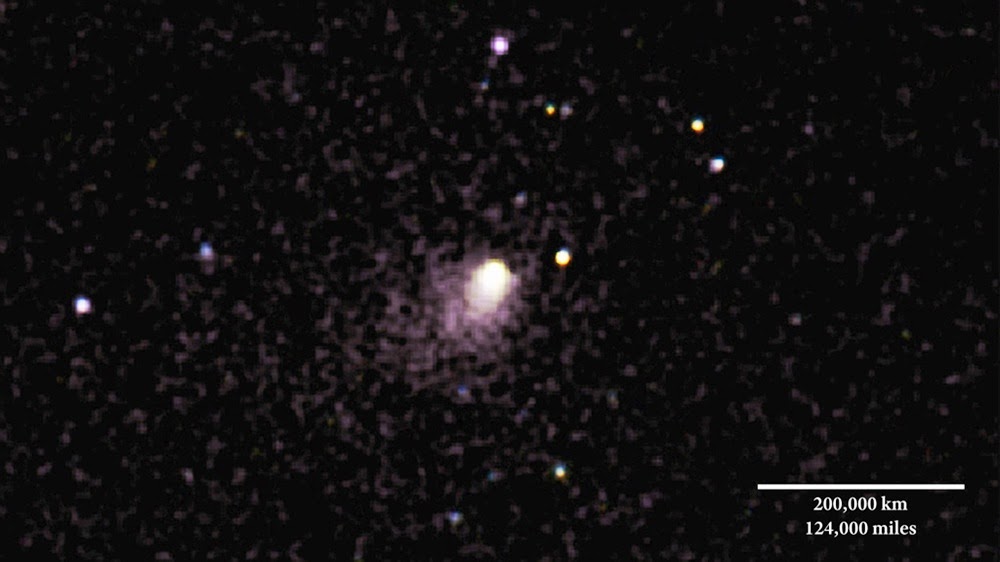
This composite of C/2013 A1 (Siding Spring) merges Swift UVOT images taken between May 27 and 29, 2014. Sunlight reflected from the comet's dust, which produces most of the light in this image, appears yellow; violet shows ultraviolet light produced by hydroxyl (OH), a molecular fragment of water.

Observations reveal how rapidly Comet Siding Spring is producing water and allow astronomers to better estimate its size.
In late May, NASA’s Swift satellite imaged comet Siding Spring, which will brush astonishingly close to Mars later this year. These optical and ultraviolet observations are the first to reveal how rapidly the comet is producing water and allow astronomers to better estimate its size.

“Comet Siding Spring is making its first passage through the inner solar system and is experiencing its first strong heating from the Sun,” said Dennis Bodewits from the University of Maryland, College Park (UMCP). “These observations are part of a two-year-long Swift campaign to watch how the comet’s activity develops during its travels.”

“Fresh” comets like Siding Spring, which is formally known as C/2013 A1, contain some of the most ancient material scientists can study. The solid part of a comet, called its nucleus, is a clump of frozen gases mixed with dust and is often described as a “dirty snowball.” Comets cast off gas and dust whenever they venture near enough to the Sun.

What powers this activity is the transformation of frozen material from solid ice to gas, a process called sublimation. As the comet approaches the Sun and becomes heated, different gases stream from the nucleus, carrying with them large quantities of dust that reflect sunlight and brighten the comet. By about two and a half times Earth’s distance from the Sun (2.5 astronomical units, or AU), the comet has warmed enough that water becomes the primary gas emitted by the nucleus.

Between May 27 and 29, Swift’s Ultraviolet/Optical Telescope (UVOT) captured a sequence of images as Comet Siding Spring cruised through the constellation Eridanus at a distance of about 229 million miles (368 million kilometers) from the Sun. While the UVOT cannot detect water molecules directly, it can detect light emitted by fragments formed when ultraviolet sunlight breaks up water, specifically hydrogen atoms and hydroxyl (OH) molecules.

“Based on our observations, we calculate that at the time of the observations the comet was producing about 2 billion billion billion water molecules, equivalent to about 13 gallons or 49 liters, each second,” said Tony Farnham from UMCP. At this rate, Comet Siding Spring could fill an Olympic-size swimming pool in about 14 hours. Impressive as it sounds, though, this is relatively modest water emission compared to other comets Swift has observed.

Based on these measurements, the team concludes that the icy nucleus of Comet Siding Spring is only about 2,300 feet (700 meters) across, placing it at the lower end of a size range estimated from earlier observations by other spacecraft.

The comet makes its closest approach to Mars on October 19, passing just 86,000 miles (138,000km) from the Red Planet — so close that gas and dust in the outermost reaches of the comet’s atmosphere, or coma, will interact with the atmosphere of Mars.

For comparison, the closest recorded Earth approach by a comet was by the now-defunct Comet Lexell, which on July 1, 1770, swept to within 1.4 million miles (2.3 million km), or about six times farther than the Moon. During its Mars flyby, Comet Siding Spring will pass more than 16 times closer than this.

Scientists have established that the comet poses no danger to spacecraft now in orbit around Mars. These missions will be pressed into service as a provisional comet observation fleet to take advantage of this unprecedented opportunity.

The Swift observations are part of a larger study to investigate the activity and evolution of new comets, which show distinct brightening characteristics as they approach the Sun not seen in other comets. Bodewits and his colleagues single out comets that can be observed by Swift at distances where water has not yet become the primary gas and repeatedly observe them as they course through the inner solar system. This systematic study will help astronomers better understand how comet activity changes with repeated solar heating.

Thursday, June 19, 2014

Molecule vital for creating water exists in dying sun-like stars

Herschel image of the Helix Nebula using the SPIRE instrument at wavelengths around 250 micrometres, superimposed on Hubble image of the nebula. The spectrum corresponds to the outer region of the Helix Nebula outlined on the SPIRE image. It identifies the OH+ molecular ion, which is needed for the formation of water. ESA’s Herschel space observatory is the first to detect this molecule in planetary nebulas – the product of dying Sun-like stars.


Using ESA's Herschel space observatory, astronomers have discovered that a molecule vital for creating water exists in the burning embers of dying Sun-like stars.
When low- to middleweight stars like our Sun approach the end of their lives, they eventually become dense, white dwarf stars. In doing so, they cast off their outer layers of dust and gas into space, creating a kaleidoscope of intricate patterns known as planetary nebulas.
These actually have nothing to do with planets, but were named in the late 18th century by astronomer William Herschel, because they appeared as fuzzy circular objects through his telescope, somewhat like the planets in our Solar System.
Over two centuries later, planetary nebulas studied with William Herschel's namesake, the Herschel space observatory, have yielded a surprising discovery.
Like the dramatic supernova explosions of weightier stars, the death cries of the stars responsible for planetary nebulas also enrich the local interstellar environment with elements from which the next generations of stars are born.
While supernovas are capable of forging the heaviest elements, planetary nebulas contain a large proportion of the lighter 'elements of life' such as carbon, nitrogen, and oxygen, made by nuclear fusion in the parent star.
A star like the Sun steadily burns hydrogen in its core for billions of years. But once the fuel begins to run out, the central star swells into a red giant, becoming unstable and shedding its outer layers to form a planetary nebula.
The remaining core of the star eventually becomes a hot white dwarf pouring out ultraviolet radiation into its surroundings.
This intense radiation may destroy molecules that had previously been ejected by the star and that are bound up in the clumps or rings of material seen in the periphery of planetary nebulas.
The harsh radiation was also assumed to restrict the formation of new molecules in those regions.
But in two separate studies using Herschel astronomers have discovered that a molecule vital to the formation of water seems to rather like this harsh environment, and perhaps even depends upon it to form. The molecule, known as OH+, is a positively charged combination of single oxygen and hydrogen atoms.
In one study, led by Dr Isabel Aleman of the University of Leiden, the Netherlands, 11 planetary nebulas were analysed and the molecule was found in just three.
What links the three is that they host the hottest stars, with temperatures exceeding 100,000ºC.
"We think that a critical clue is in the presence of the dense clumps of gas and dust, which are illuminated by UV and X-ray radiation emitted by the hot central star," says Dr Aleman.
"This high-energy radiation interacts with the clumps to trigger chemical reactions that leads to the formation of the molecules."
Meanwhile, another study, led by Dr Mireya Etxaluze of the Instituto de Ciencia de los Materiales de Madrid, Spain, focused on the Helix Nebula, one of the nearest planetary nebulas to our Solar System, at a distance of 700 light years.
The central star is about half the mass of our Sun, but has a far higher temperature of about 120,000ºC. The expelled shells of the star, which in optical images appear reminiscent of a human eye, are known to contain a rich variety of molecules.
Herschel mapped the presence of the crucial molecule across the Helix Nebula, and found it to be most abundant in locations where carbon monoxide molecules, previously ejected by the star, are most likely to be destroyed by the strong UV radiation.
Once oxygen atoms have been liberated from the carbon monoxide, they are available to make the oxygen-hydrogen molecules, further bolstering the hypothesis that the UV radiation may be promoting their creation.
The two studies are the first to identify in planetary nebulas this critical molecule needed for the formation of water, although it remains to be seen if the conditions would actually allow water formation to proceed.
"The proximity of the Helix Nebula means we have a natural laboratory on our cosmic doorstep to study in more detail the chemistry of these objects and their role in recycling molecules through the interstellar medium," says Dr Etxaluze.
"Herschel has traced water across the Universe, from star-forming clouds to the asteroid belt in our own Solar System," says Göran Pilbratt, ESA's Herschel project scientist.
"Now we have even found that stars like our Sun could contribute to the formation of water in the Universe, even as they are in their death throes."
"Herschel planetary nebula survey (HerPlaNS). First detection of OH+ in planetary nebulae," by I. Aleman et al., and "Herschel spectral-mapping of the Helix Nebula (NGC 7293): extended CO photodissociation and OH+ emission," by M. Etxaluze et al., are published in Astronomy & Astrophysics.
HerPlaNS (The Herschel Planetary Nebulae Survey) is a survey of 11 planetary nebulas aiming the study the formation and evolution of the circumstellar material by tracing the dust and gas components. The HerPlaNS team is led by Toshiya Ueta from the University of Denver.
The MESS (Mass loss of Evolved StarS) consortium studies a wide variety of evolved stars (including planetary nebulas) to better understand the mass loss in these objects, the dust and gas chemistry in the ejected material, and the processes shaping the nebulae. The MESS consortium is led by Martin Groenewegen (Royal Observatory of Belgium) and the study of planetary nebulas within the group is led by Peter van Hoof (Royal Observatory of Belgium).

Sunday, June 15, 2014

Giant telescopes pair up to image near-Earth asteroid

NASA scientists used Earth-based radar to produce these sharp views of the asteroid designated 2014 HQ124 on June 8, 2014.

NASA scientists using Earth-based radar have produced sharp views of a recently discovered asteroid as it slid silently past our planet. Captured on June 8, 2014, the new views of the object designated 2014 HQ124 are some of the most detailed radar images of a near-Earth asteroid ever obtained.

Scientists Marina Brozovic and Lance Benner of NASA’s Jet Propulsion Laboratory (JPL) in Pasadena, California, led the radar observations. The researchers worked closely with Michael Nolan, Patrick Taylor, Ellen Howell, and Alessondra Springmann at Arecibo Observatory in Puerto Rico to plan and execute the observations.

2014 HQ124 appears to be an elongated, irregular object that is at least 1,200 feet (370 meters) wide on its long axis. “This may be a double object, or ‘contact binary,’ consisting of two objects that form a single asteroid with a lobed shape,” Benner said. The images reveal a wealth of other features, including a puzzling pointy hill near the object’s middle, on top as seen in the images.

The 21 radar images were taken over a span of 4.5 hours. During that interval, the asteroid rotated a few degrees per frame, suggesting its rotation period is slightly less than 24 hours.

At its closest approach to Earth on June 8, the asteroid came within 776,000 miles (1.25 million kilometers), or slightly more than three times the distance to the Moon. Scientists began observations of 2014 HQ124 shortly after the closest approach when the asteroid was between about 864,000–902,000 miles (1.39–1.45 million kilometers) from Earth.

Each image in the collage and movie represents 10 minutes of data.

The new views show features as small as about 12 feet (3.75 meters) wide. This is the highest resolution currently possible using scientific radar antennas to produce images. Such sharp views for this asteroid were made possible by linking together two giant radio telescopes to enhance their capabilities.

To obtain the new views, researchers paired the 230-foot (70m) Deep Space Network antenna at Goldstone, California, with two other radio telescopes, one at a time. Using this technique, the Goldstone antenna beams a radar signal at an asteroid and the other antenna receives the reflections. The technique dramatically improves the amount of detail that can be seen in radar images.

To image 2014 HQ124, the researchers first paired the large Goldstone antenna with the 1,000-foot (305m) Arecibo radio telescope in Puerto Rico. They later paired the large Goldstone dish with a smaller companion, a 112-foot (34m) antenna, located about 20 miles (32km) away.

A recent equipment upgrade at Arecibo enabled the two facilities to work in tandem to obtain images with this fine level of detail for the first time.

“By itself, the Goldstone antenna can obtain images that show features as small as the width of a traffic lane on the highway,” said Benner. “With Arecibo now able to receive our highest-resolution Goldstone signals, we can create a single system that improves the overall quality of the images.”

The first five images in the new sequence — the top row in the collage — represent the data collected by Arecibo and are 30 times brighter than what Goldstone can produce observing on its own.

Scientists were fortunate to be able to make these radar observations at all, as this particular asteroid was only recently discovered. NASA’s NEOWISE mission, a space telescope adapted for scouting the skies for the infrared light emitted by asteroids and comets, first spotted the space rock April 23, 2014.

For asteroids, as well as comets, radar is a powerful tool for studying the objects’ sizes, shapes, rotation, surface features, and orbits. Radar measurements of asteroid distances and velocities enable researchers to compute orbits much further into the future than if radar observations were not available.

NASA detects, tracks, and characterizes asteroids and comets passing close to Earth using both ground- and space-based telescopes. The Near-Earth Object Program, commonly called “Spaceguard,” discovers these objects, characterizes a subset of them, and identifies their orbits to determine if any could be potentially hazardous to our planet. To date, U.S. assets have discovered more than 98 percent of the known near-Earth objects.

Along with the resources NASA puts into understanding asteroids, it also partners with other U.S. government agencies, university-based astronomers, and space science institutes across the country that are working to find, track, and understand these objects better. In addition, NASA values the work of numerous highly skilled amateur astronomers, whose accurate observational data helps improve asteroid orbits after they are found.